
Title
Nobody should be on‑call.
Boris Tane, founder of Polylane
0:00 to 0:08. Hi, I'm Boris, I'm building Polylane. Nobody should be on-call.
Tsunami of code
A tsunami of code hits production every day
0:08 to 0:25. Every day, a tsunami of code hits production. Pull request after pull request, written by Claude Code, Codex, Cursor, Copilot, Devin: more code than any team could ever read, and it's only speeding up. (Illustrative feed.)
Nobody knows
Nobody knows what's going on anymore
 #incidents
0:25 to 0:38. And nobody knows what's going on anymore. Hundreds of services, thousands of resources, connected in ways nobody wrote down. Every team has a channel like this. Did someone change the bot rules? Which deploy broke checkout? Who owns orders-db? Nobody answers, because nobody knows.
Teams building agents
Teams building agents have it worse
Agents are chaotic by default: loops, retries, wrong tools, runaway costs.
0:38 to 0:55. And teams building agents have it worse. Agents are chaotic by default. Every run should go straight from the task to done. Instead they loop, they retry until they give up, they pick the wrong tool, they wander until they time out. Only a couple make it. None of it shows up on a dashboard. (Illustrative runs.)
Hunting for answers
When things go wrong, engineers are left hunting for answers
0:55 to 1:08. So when something goes wrong, engineers are left hunting for answers. Ten tabs, five tools, a Slack thread, and a customer waiting.
Expensive
And it's a pretty expensive problem
%
of engineering time goes to outages, up from 33% a year ago.
New Relic Observability Forecast, Sept 2026
1:08 to 1:20. And it's a pretty expensive problem. Engineers now spend 37% of their time on outages, up from 33% a year ago. That's more than a third of your engineering team, firefighting.
Understands your system
Polylane understands your entire system
Every resource on every cloud, and how they connect.
1:20 to 1:35. Polylane understands your entire system. It connects to your clouds, your code and your tools, and maps every resource and how they connect: the context graph.
24/7
It keeps an eye on prod, 24/7
1:35 to 1:47. It keeps an eye on production, 24/7. Every deploy, every signal, against what's normal for that resource. It finds the issues you didn't know were there.
Fixes it for you
And when something's wrong, it fixes it for you
1:47 to 2:00. And when something's wrong, it fixes it for you. It finds the root cause in your code, writes the fix, and opens the pull request. You merge it.
Cloudflare, 18 Nov 2025
It could have prevented the Cloudflare outage of 2025
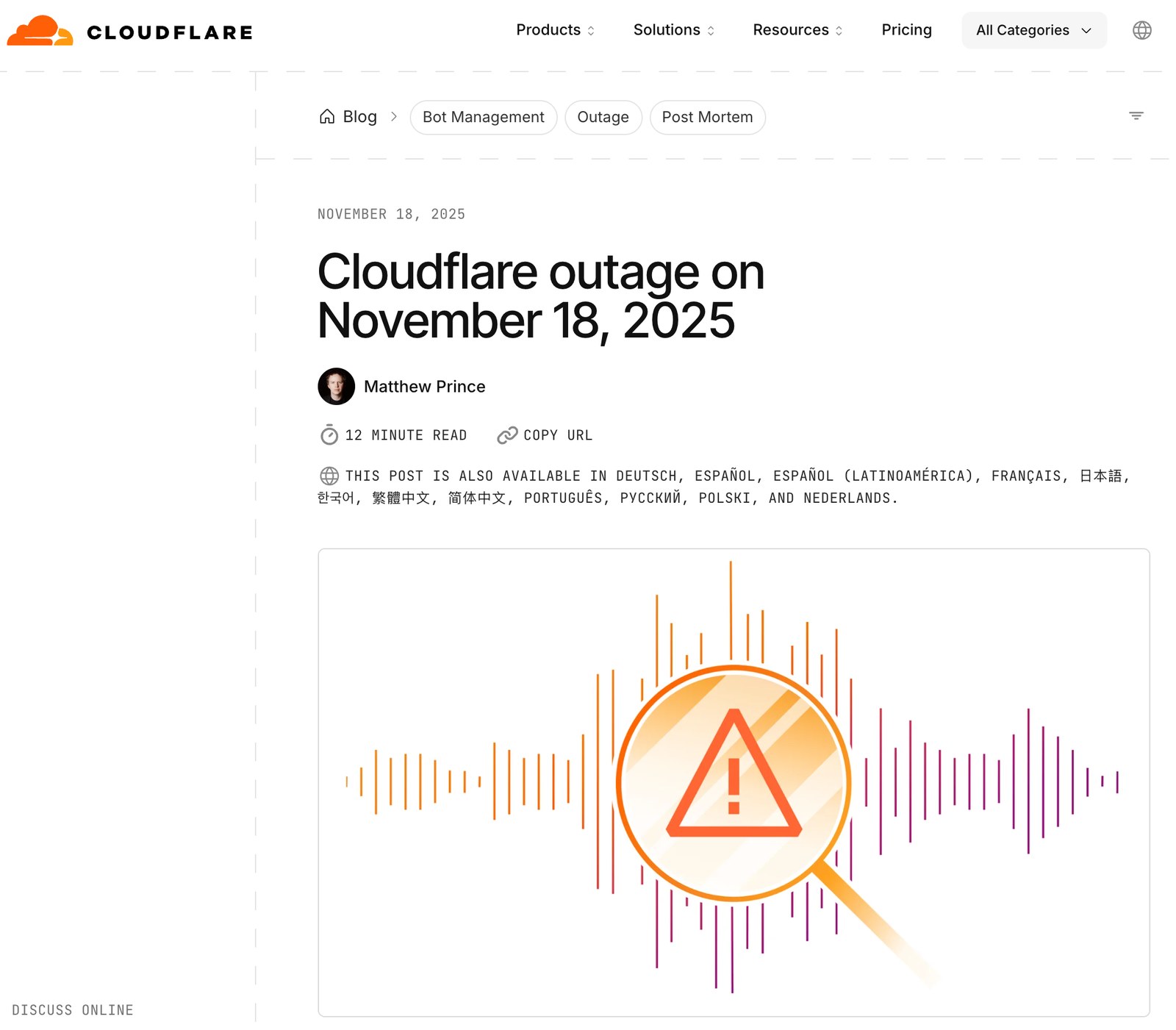
2:00 to 2:15. Matthew, you wrote this one. 18 November last year: a permissions change made a query return duplicate rows, the Bot Management file doubled, and the proxy fell over across the network. Polylane could have prevented it.
Catch risky changes
Because it catches risky changes before they merge
Load bot features from the new query #1182
@@ features/bot.sql+ SELECT name, type FROM system.columns+ WHERE table = 'http_requests_features'

polylane commented just now
Caution
Merging this may take down the proxy everywhere.The query now also returns the r0 database's columns, so the feature file goes past the proxy's 200-feature limit on every node at once.
bot feature file · features per file · production, last 48h
Polylane production impact High impact
✕Merging is blocked
2:15 to 2:35. Because it catches risky changes before they merge. Every pull request, whether a human or an agent wrote it, is reviewed against live production. This is what it would have said about that change. Turn on the check, and the merge is blocked. (Illustration of the November change.)
Fleet video
2:35 to 3:00. And when something does break, Polylane spins up a fleet. One agent per source, per question, all at once, sharing what they find until they agree on the cause. Talk over it and move on when you're ready.
Integrations
Plugs into everything developers already run
3:00 to 3:10. It plugs into everything developers already run. No new SDK, no migration.
Loved by developers
Loved by developers
3:10 to 3:25. And developers love it. Every one of these is a real post, on X or Product Hunt.
Two of today's startups
Two of today's startups already run on Polylane

3:25 to 3:35. And two of the startups on this stage today already run on Polylane: Supermemory and Parakeet.
Durable Objects
 Built on Cloudflare
Our agent runs on Durable Objects
Every investigation is one agent in its own Durable Object, running for hundreds of turns. Every resource we watch is a Durable Object too.
3:35 to 3:50. We built all of it on Cloudflare. Our agent runs on Durable Objects: every investigation is one agent with its own state, running for hundreds of turns. And every resource we watch is its own Durable Object, waking on its own alarm.
Entirely built on Cloudflare
Polylane is entirely built on Cloudflare
3:50 to 4:02. In fact Polylane is entirely built on Cloudflare. 130 Workers, more than 200 Durable Object classes, and almost every product on the developer platform.
Why me

I've spent my entire career on this problem
 2021
Founded Baselime
2024Led Workers Observability
2026Founded Polylane
4:02 to 4:15. Why me. I founded Baselime in 2021. You bought it, and I led Workers Observability here. I've watched what developers do when production breaks. I left to build what comes after.
Team
The team
 Matanya
 Groq
 Justin
 Webflow
 Vi
 Robinhood
 Fernando
 Adaptive Computer
4:15 to 4:25. And I'm not doing it alone. Matanya comes from Groq, Justin from Webflow, Vi from Robinhood, and Fernando from Adaptive Computer. Matanya and Fernando have both founded companies before.
Close
Nobody should be on‑call.
polylane.com · boris@polylane.com
4:25 to 4:35. Agents write the code now. Polylane understands it, watches it, and fixes it. Nobody should be on-call. Thank you.